
Journey through lucky shrines and nature to experience literature and feel refreshed [Nichinan]
Enjoy this course to the max during the fall foliage season, with prime locations like the Sekkakei Ravine and the ginkgo tree at the former Hinoue Elementary School.This course is a treasure trove of nature where rare plants and creatures can be discovered. There is also the 'Fukumaki Hotaru-no-Kuni', Japan's No. 1 firefly viewing spot where Himebotaru and Genjibotaru fireflies dance boisterously amidst a sky full of stars.
- Distance36.5km
- Elevation gain582m
- Descent△583m
- Maximum elevation481m
- Average time3 hours
- Recommended seasonSpring, Fall to Winter
Route map
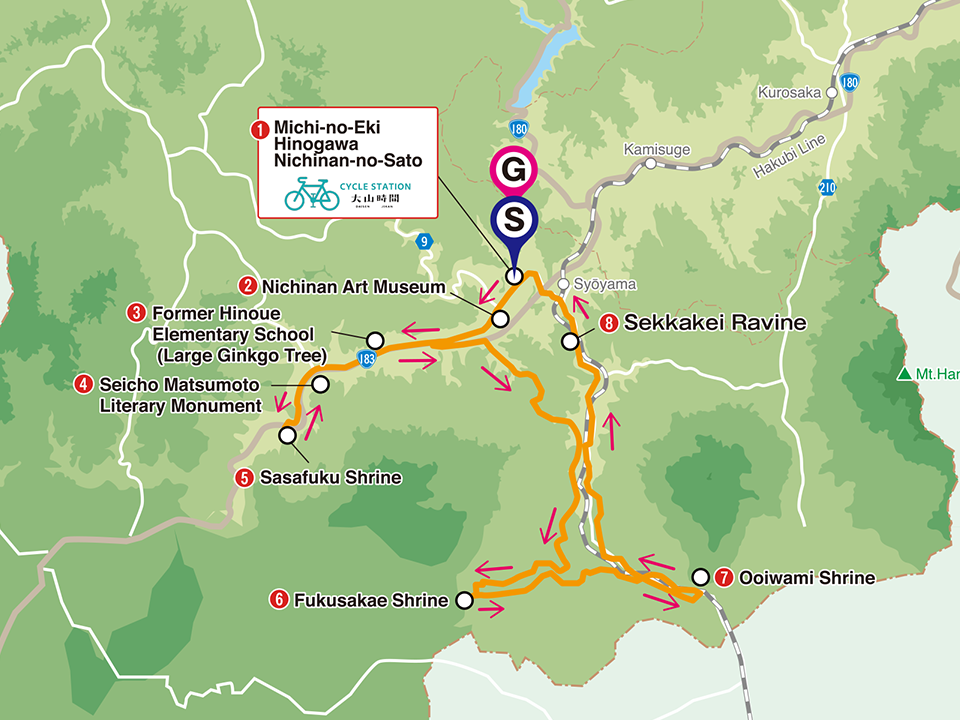

Tourist information for this route

1. Michi-no-Eki Hinogawa Nichinan-no-Sato
Cycle station. The Michi-no-Eki service station is a backdrop for the changing faces of the seasons: fresh greenery in spring, ayu fish swimming up the Hino River in summer, crimson fall leaves and snowy landscapes in winter. There is a wide selection of fresh vegetables and rice (proudly grown in mid-altitude areas with clear water!), mochi and a variety of handicrafts on offer. The restaurant's Nichinan Dam Curry is also very popular!

2. Nichinan Art Museum
Featuring pieces of art collected by the founder of Sakura Craypas (and a Nichinan Town native!) Rinzo Satake, this museum features a collection of paintings and sculptures by modern artists such as Takeji Fujishima, Takeshi Hayashi, Gyokudo Kawai and Ryuzaburo Umehara, a native of Nichinan Town and another founder of Sakura Craypas. The museum also exhibits Western-style paintings, woodblock prints and sketches from Toshio Ashiba, an artist born in Nichinan Town who was active in France.

3. Former Hinoue Elementary School (Large Ginkgo Tree)
This approx. 100 year old large Ginkgo tree stands in the schoolyard of the former Hinoue Elementary School. The tree brings back memories for school alumni and local residents. Its popularity has grown since it was featured in magazines and TV and many people from inside and outside the prefecture come to visit the tree in mid-November, when its leaves turn golden brown/yellow. The tree's distinctive shape makes it an excellent setting for photos!

4. Seicho Matsumoto Literary Monument
A literary monument to honour Seicho Matsumoto, a master of socially aware fiction. Yado, Nichinan Town, a place beloved by his father Minetaro for all his life, features prominently in Seicho's essays and novels. The monument stands quietly in Yado and is written in Seicho's own handwriting, one of the few monuments of its kind in Japan.

5. Sasafuku Shrine
A shrine dedicated to Emperor Kourei and his family. An ancient shrine with a history of over 1,100 years, it enshrines the chief guardian deity of Hino Town, revered in earlier times as a guardian deity of iron production. Legend has it that this location is where Emperor Kourei and his family pacified an evil spirit that had taken root on Mt. Kirin.

6. Fukusakae Shrine
A shrine with a very auspicious name: 'Fuku ga Sakaeru' ('fortune will flourish'). In ancient times, the shrine was called 'Tanaka Daimyoujin' and was worshipped as a local deity to protect the surrounding area.However, in 1913 it was merged with eight neighboring shrines and renamed Fukusakae Shrine. The shrine is dedicated to Tamayorihime as its main deity and 30 others, including Sugawara no Michizane.

7. Ooiwami Shrine
According to the Kojiki, Okuninushi no Mikoto was twice slain by his jealous half-brother Yasogami, and resurrected both times. This shrine is said to be the site of his second resurrection and was originally named Ookuninushi no Daimyoujin. The shrine is famed as a powerful spot for revival and regeneration after repeated suffering.

8. Sekkakei Ravine
A large ravine stretching 12km north-south centered on the confluence of the Hino and Iwami Rivers in the Oku-Hino area, surrounded by dynamic natural beauty. The ravine, rich in beauty in all seasons, is divided into the 'masculine' southern gorge with its many strange-shaped rocks, and the more gentle and 'feminine'-looking north gorge. In 1933, the ravine was recognized as a place of scenic beauty by the Ministry of Education, Science, Sports and Culture.
How to access the course (starting point)
For cars
About 40 minutes from Kofu IC.
By train
30 minutes walk from Shoyama Station on the JR Hakubi Line.