
Journey down from the natural magnificent Mt.Daisen towards the shimmering blue sea of Japan[Daisen]
Mt. Daisen National Park is one of Tottori Prefecture's most iconic natural attractions. Listen to the chirping of wild birds while cycling through beech forests and encounter shrines and temples boasting 1300 years of history. This course is a downhill ride with sea breezes, rural views and a scenery that changes from the seas to the mountains.
- Distance25.4km
- Elevation gain155m
- Descent△854m
- Maximum elevation737m
- Average time2 hours
- Recommended seasonSummer, Fall
Route map
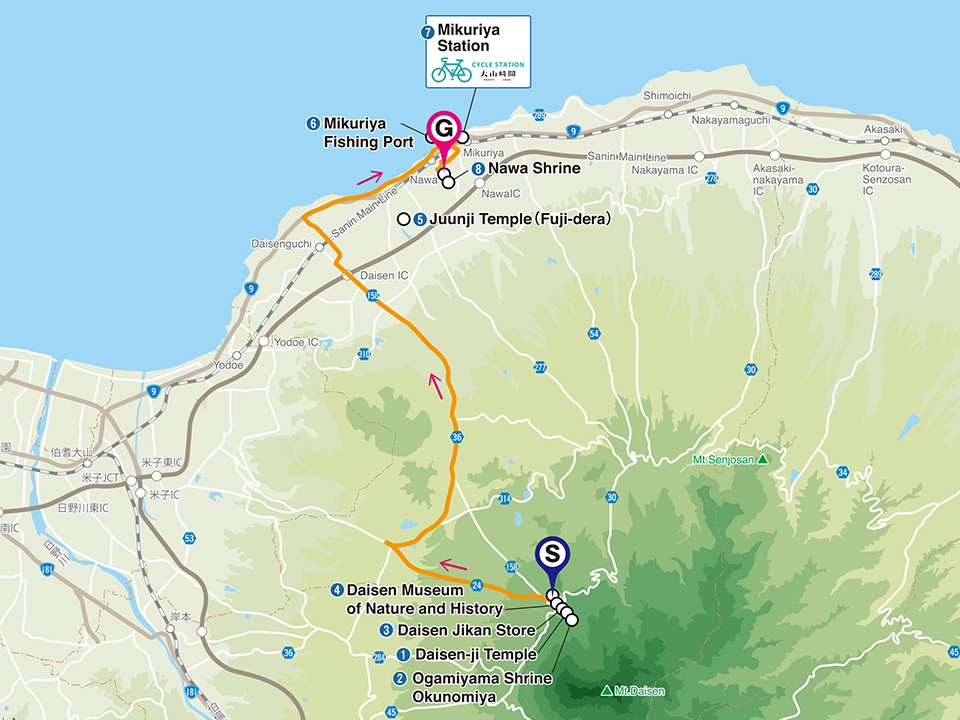

Tourist information for this route

1. Daisen-ji Temple
Daisen-ji Temple prospered as a training hall for the followers of Shugendo, who devoted themselves to mountain ascetism. Since the Heian period, as mountain worship became increasingly Buddhist, the number of temples increased and at its peak, it had more than 100 temples and 3000 monks, making it a major power as prosperous as Mt. Hiei, Mt. Yoshino and Mt. Koya. The main hall, an ancient temple of the Tendai sect, was destroyed in a fire in 1928 and rebuilt in 1951.

2. Ogamiyama Shrine Okunomiya
On September 30th 1875, the Daisen-ji Temple name was abolished due to the split of Shintoism and Buddhism and the movement to abolish Buddhism. Thus, the shrine building of Daichimyo-gongen was separated from Daisen-ji Temple and repurposed as the Okunomiya of Ogamiyama Shrine, where the deity Okunishi-no-Mikoto is enshrined. The largest Gongen-zukuri in Japan is on the shrine grounds, visible after passing through the longest approach road (700m) paved with natural stone. The shrine has also been listed as a National Cultural Property.

3. Daisen Jikan Store
A concept store under the Daisen Jikan theme and the perfect place to stop by after climbing Mt. Daisen or visiting Daisen-ji Temple or Ogamiyama Shrine. Why not treat your tired body with some Gongen dumplings or Hoshitori gelato? "Experience a Journey through Time" with products full of the charms Tottori Prefecture has to offer!

4. Daisen Museum of Nature and History
A museum located at the front of Mt. Daisen's northern face, it almost looks like you are entering the mountain itself! The Daisen Museum of Nature and History weaves together the nature, history and culture of Daisen in an easy to understand and fun way. Every year, many visitors come to learn more about the backstory of Daisen and there's no better place to do so!

5. Juunji Temple(Fuji-dera)
Juunji Temple was founded approx. 600 years ago in the first year of the Kenmu Restoration, the period in which Emperor Go-Daigo and Nagatoshi Nawa were active. The principle deity of the temple is Sho-Kanzeon Bosatsu. The temple is also known as 'Fuji-dera' due to the four large wisteria trees on the grounds. The wisteria here is a type of rokushaku wisteria, a rare type in Japan in which clusters of flowers hang downwards at approximately 6 feet (1.8m). The long-established 'Wisteria Festival' is held every year during Golden Week.

6. Mikuriya Fishing Port
Despite its small size, this port actually bosats the 2nd largest catch of fish in Tottori Prefecture and serves as the 2nd major port in the western region, after Sakaiminato. In particular, the market has the largest catch of turban shells in the prefecture, also known for their large size. With a 2-floor shop and restaurant, visitors can purchase, eat and enjoy fresh fish to their heart's content!

7. Mikuriya Station
Cycle Station. The "oldest station in the Sanin region" that strongly retains the vestiges of the time when the Sanin Railway was first established. The antique station building interior and luggage racks are left as they had appeared 100 years ago. In 2002, the old station building was renovated in commemoration of the 100th anniversary of the Sanin Railway's founding. The station office is also used as the 'Mikuriya Market', where vegetables and fresh produce harvested that morning are sold.

8. Nawa Shrine
Nawa Shrine was founded in the latter half of the 17th century by the feudal lord of Tottori, Ikeda Mitsunaka. It was moved to its current location in 1883 when its ownership was transferred and became a Imperial Shrine of Special Status. It is the largest shrine in Tottori Prefecture and famous for its cherry blossoms at the entrance. It contains one of the largest 'cherry blossom tunnels' in the Sanin region!
How to access the course (starting point)
For cars
20 minutes from San'in Expressway Daisen IC.
By train
30 minutes by bus from Daisenguchi Station on the JR San'in Main Line.